About

Why

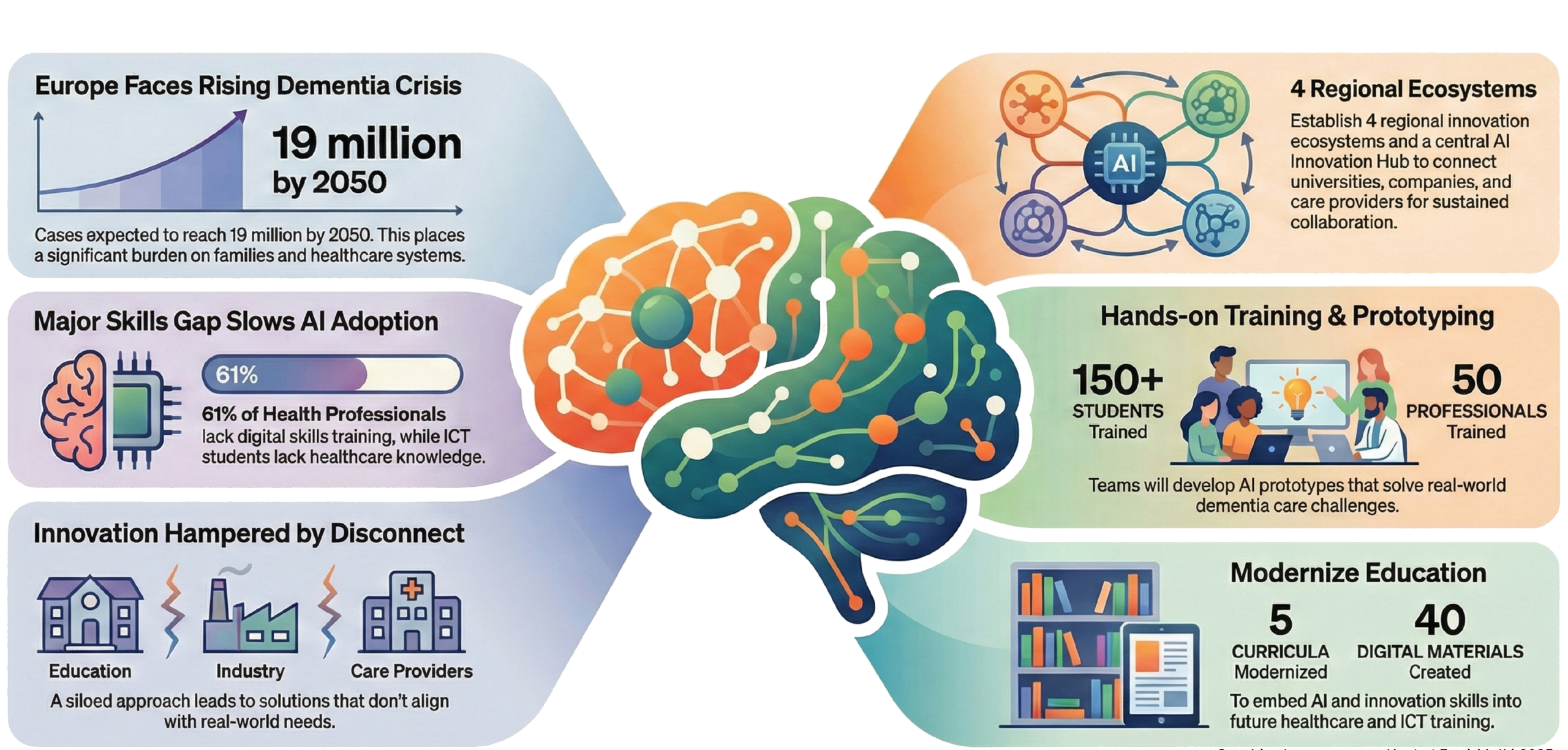
The increasing prevalence of dementia and mild cognitive impairment (MCI) represents one of the most significant societal and healthcare challenges facing Europe. At the same time, advances in artificial intelligence, data-driven technologies, and digital health solutions are creating new opportunities for early detection, risk assessment, and personalised intervention. However, the effective and responsible deployment of these technologies requires targeted skills development, interdisciplinary education, and stronger alignment between education systems and labour market needs.

DETECT 2.0 is an Innovation Alliance funded under the Erasmus+ Programme that aims to address these challenges by strengthening Europe’s innovation capacity in the field of AI-enabled early detection of cognitive impairment. The project focuses on identifying emerging skills needs and developing innovative education and training solutions that support the uptake of artificial intelligence technologies in healthcare contexts.

What

Through enhanced cooperation between higher education institutions, vocational education and training providers, research organisations, healthcare stakeholders, SMEs, and industry, DETECT 2.0 develops and pilots new curricula, learning methodologies, digital tools, and training frameworks. These activities are designed to improve relevance to the labour market, promote knowledge transfer, and support the upskilling and reskilling of students, educators, and professionals.

By fostering cross-sector collaboration, applied learning, and long-term sustainability, DETECT 2.0 contributes to the modernisation of education and training systems, supporting Europe’s digital transformation and enabling a future-ready workforce capable of integrating artificial intelligence into dementia and MCI detection pathways in an ethical, effective, and socially responsible manner.